IMARC Group has recently released a new research study titled “United States Biologics Market Size, Share, Trends and Forecast by Source, Product, Disease, Manufacturing and Region, 2026-2034”, offering a detailed analysis of the market drivers, segmentation, growth opportunities, trends, and competitive landscape to understand the current and future market scenarios.
United States Biologics Market Size & Share 2026-2034
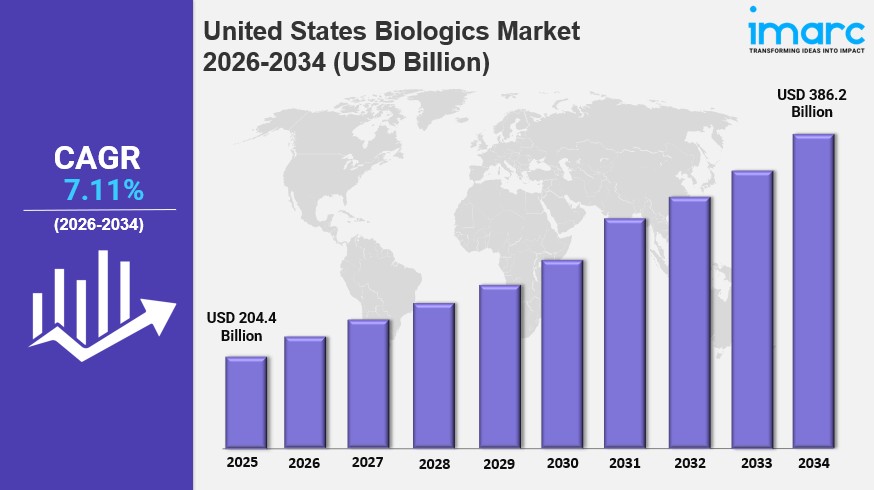
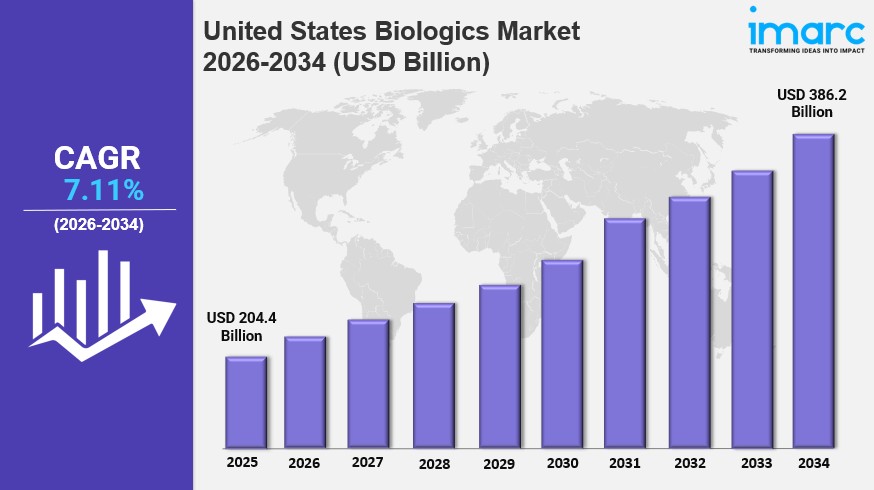
The United States biologics market size was valued at USD 204.4 Billion in 2025 and is projected to reach USD 386.2 Billion by 2034, exhibiting a CAGR of 7.11% during 2026-2034. The market is primarily driven by the rapid adoption of bioprocessing technologies for efficiency, growing expansion of biosimilars addressing affordability, and rising AI integration in drug discovery, clinical trials, and manufacturing, collectively enhancing innovation, reducing costs, and improving access to advanced therapies.
According to the CDC, an estimated 129 Million Americans have at least one chronic disease, with chronic diseases accounting for 90% of the annual USD 4.1 Trillion healthcare expenditure, highlighting the need for innovative biologics and further shaping the United States biologics market share throughout the forecast period.
Key Market Statistics at a Glance
- Base Year: 2025
- Historical Years: 2020-2025
- Forecast Period: 2026-2034
- Market Size (2025): USD 204.4 Billion
- Projected Market Size (2034): USD 386.2 Billion
- Growth Rate: CAGR of 7.11% (2026-2034)
Explore Opportunities in the United States Biologics Market: Download the IMARC Sample Report: https://www.imarcgroup.com/united-states-biologics-market/requestsample
Key Growth Drivers and Trends in the United States Biologics Market
Growth in the United States biologics market is being driven by growing adoption of advanced bioprocessing technologies, as single-use bioreactors, continuous manufacturing, and high-throughput screening systems streamline manufacturing processes. Rentschler Biopharma’s Milford facility, operational since July 11, 2024, with four 2,000L single-use bioreactors, doubled cGMP capacity for complex biologics, supporting innovative therapies and reducing production costs while maintaining high-quality standards.
One of the leading United States biologics market trends is rapid expansion of the biosimilars market, as the FDA’s Biosimilar Approval Pathway allows easier market entry, increasing competition while decreasing treatment costs for chronic diseases like cancer and autoimmune disorders. On July 2, 2024, Sobi began a rolling BLA submission for SEL-212, a novel biologic aimed at serum urate levels in chronic refractory gout, reflecting sustained pharmaceutical investment in biosimilar R&D as branded biologic patents expire.
Another key factor supporting United States biologics market growth is integration of artificial intelligence in biologics development, as AI-powered platforms analyze enormous datasets to identify promising biologic candidates, cutting down time and cost involved in traditional R&D. AI streamlines patient recruitment and monitors real-time data in clinical trials, while also supporting quality control monitoring and predictive maintenance in bioprocessing, with strategic partnerships such as the May 15, 2024 agreement between Galapagos NV and Blood Centers of America decentralizing CAR-T therapy manufacturing across 50 U.S. centers for rapid seven-day vein-to-vein delivery.
Speak to an Analyst: https://www.imarcgroup.com/request?type=report&id=20441&flag=C
United States Biologics Industry Segmentation Insights
Breakup by Source:
- Microbial: Serves as an efficient host system for producing recombinant proteins, enzymes, and vaccines, valued for rapid growth rates and cost-effectiveness in large-scale production.
- Mammalian: Critical for producing complex biologics such as monoclonal antibodies, fusion proteins, and cell therapies, with CHO cells dominating this segment.
- Others: Includes additional biologic production systems supporting specialized therapeutic applications.
Breakup by Product:
- Monoclonal Antibodies: Represents a mainstay of the market, used widely for cancer, autoimmune diseases, and infections, with continued innovation in antibody-drug conjugates and bispecific antibodies.
- Vaccines: Growing at an impressive rate driven by advancements in mRNA technology and emphasis on pandemic preparedness.
- Recombinant Proteins: Widely used in treating diabetes, anemia, and growth disorders, with biosimilars improving accessibility and affordability.
- Antisense, RNAi and Molecular Therapy: Supports advanced molecular-level therapeutic approaches for complex disease treatment.
- Others: Includes additional biologic product categories supporting broader therapeutic demand.
Breakup by Disease:
- Oncology: Leads the market given significant cancer occurrence and rising need for targeted treatments, with continuous progress in CAR-T cell therapy and personalized medicine.
- Immunological Disorders: Witnessing strong growth with rising incidence of diseases like rheumatoid arthritis, psoriasis, and inflammatory bowel disease.
- Cardiovascular Disorders: Gaining ground through innovative treatments such as PCSK9 inhibitors for cholesterol regulation and growth in regenerative therapies.
- Hematological Disorders: Supports biologic-based treatment approaches for blood-related conditions.
- Others: Includes additional disease categories supported by biologic therapies.
Breakup by Manufacturing:
- Outsourced: Increasing as companies rely on contract research and manufacturing organizations for cost-efficient production, access to sophisticated technologies, and scalable facilities.
- In-House: Remains vital for companies prioritizing control over manufacturing processes, quality assurance, and intellectual property, particularly for high-value biologics.
Breakup by Region:
- Northeast: Driven by a concentration of leading biotechnology and pharmaceutical companies, particularly in Massachusetts and New York, supported by robust R&D infrastructure.
- Midwest: Growing rapidly in biologics manufacturing, with significant contributions from Illinois and Indiana and strong university-biotech collaborations.
- South: Benefits from major biopharmaceutical companies and favorable business climates in states like North Carolina and Texas, supported by growing clinical trial activity.
- West: Dominates biologics innovation, particularly in California, hosting Silicon Valley biotechnology companies and leading research in CAR-T cell therapies and mRNA vaccines.
Key Challenges and Growth Opportunities in the United States Biologics Market
The United States biologics market faces challenges including high manufacturing and R&D costs, complex regulatory compliance requirements, and the technical challenges of scaling advanced bioprocessing technologies while maintaining consistent quality standards.
Despite these challenges, the market offers considerable growth opportunities driven by continued biosimilar expansion, growing AI integration across drug discovery and manufacturing, and rising healthcare expenditure supported by favorable reimbursement policy. Supportive FDA frameworks such as fast-track approvals and expanding investments in R&D for next-generation treatments are expected to create substantial opportunities for long-term growth in the United States biologics market.
Competitive Landscape
Competition in the United States biologics market comes through key pharmaceutical and biotech innovators continuing to invest heavily in R&D activities, boasting advanced portfolios for next-generation monoclonal antibodies, vaccines, and gene therapies. Emerging startups and contract research organizations (CROs) are also contributing niche biologics development and outsourcing solutions, intensifying competition and ensuring both accessibility and affordability, with strategic partnerships and acquisitions serving as primary market-positioning strategies.
Author IMARC Group
IMARC Group is a leading global market research company providing data-driven insights and expert consulting services to businesses seeking to achieve their strategic objectives. With a multidisciplinary team of industry experts, IMARC delivers reliable market intelligence across sectors including Chemicals and Materials, Healthcare, Technology, Agriculture, and Retail.
Contact Us:
IMARC Group
Email: sales@imarcgroup.com
United States: +1-201-971-6302