IMARC Group has recently released a new research study titled “United States Commercial Real Estate Market Size, Share, Trends and Forecast by Type and Region, 2026-2034”, offering a detailed analysis of the market drivers, segmentation, growth opportunities, trends, and competitive landscape to understand the current and future market scenarios.
United States Commercial Real Estate Market Size & Share 2026-2034
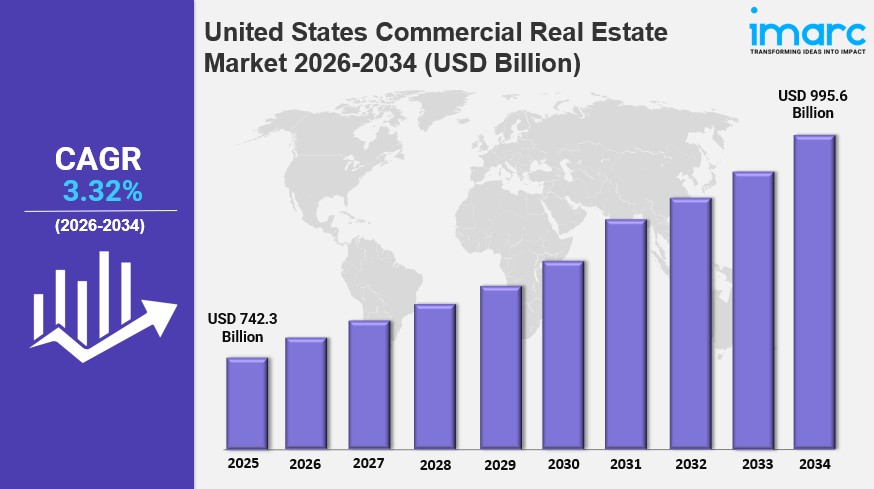
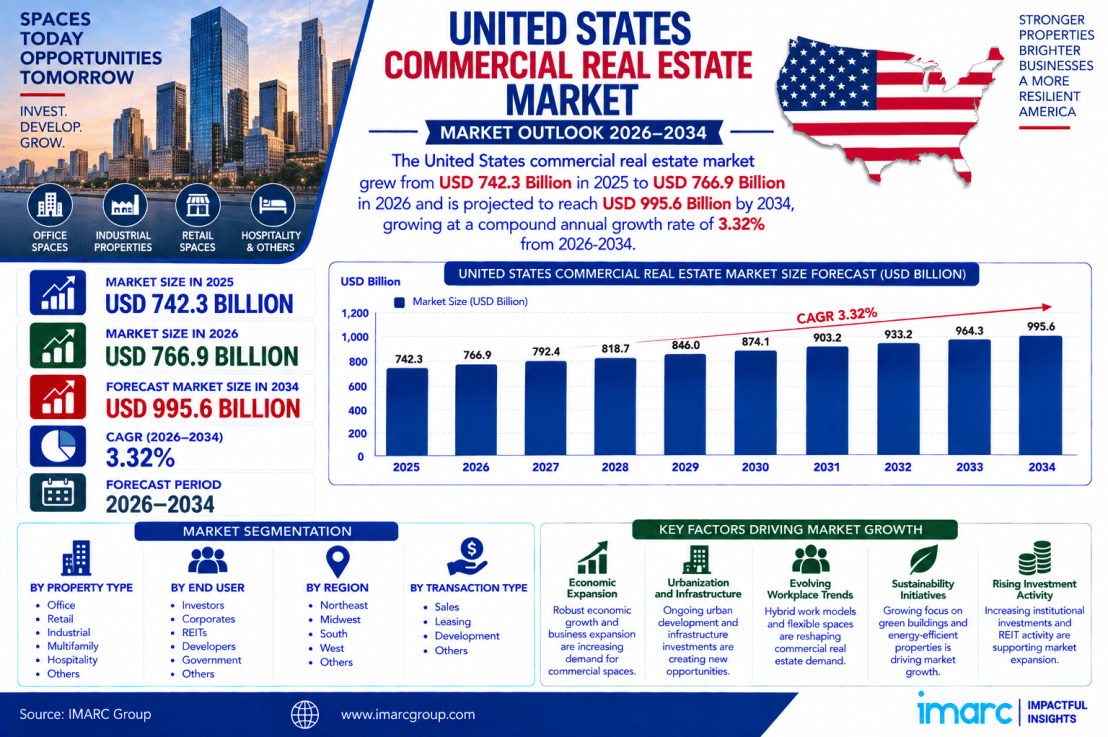
The United States commercial real estate market grew from USD 742.3 Billion in 2025 to USD 766.9 Billion in 2026 and is projected to reach USD 995.6 Billion by 2034, expanding at a CAGR of 3.32% during 2026–2034. The market is experiencing steady expansion, driven by robust demand for industrial and logistics properties, sustained e-commerce growth, and population migration toward economically vibrant regions.
Favorable business climates in emerging metropolitan areas, coupled with ongoing infrastructure development and technological advancements in building systems, continue to attract institutional investments in 2026. The diversified nature of property types, including offices, retail spaces, warehouses, and multifamily housing, supports resilient performance across economic cycles, strengthening the United States commercial real estate market share throughout the forecast period.
Key Market Statistics at a Glance
- Base Year: 2025
- Historical Years: 2020-2025
- Forecast Period: 2026-2034
- Market Size (2025): USD 742.3 Billion
- Market Size (2026): USD 766.9 Billion
- Projected Market Size (2034): USD 995.6 Billion
- Growth Rate: CAGR of 3.32% (2026-2034)
- Leading Type (2025): Industrial, holding a 26.96% share
- Leading Region (2025): South, holding a 29% share
Explore Opportunities in the United States Commercial Real Estate Market: Download the IMARC Sample Report: https://www.imarcgroup.com/united-states-commercial-real-estate-market/requestsample
Key Growth Drivers and Trends in the United States Commercial Real Estate Market
Growth in the United States commercial real estate market is being driven by the sustained expansion of e-commerce, which continues to serve as a primary catalyst for demand within the industrial and logistics segment. The United States e-commerce market size reached USD 1,236.5 Billion in 2025, with online retail sales capturing an increasing share of total consumer spending, necessitating extensive warehouse networks positioned near major population centers to facilitate rapid order fulfillment. The Census Bureau reported that projected U.S. retail e-commerce sales for the third quarter of 2025 reached USD 310.3 Billion, reflecting continued momentum that is compelling retailers to expand both large-scale regional distribution centers and smaller last-mile facilities.
One of the leading United States commercial real estate market trends is population migration toward Sun Belt states, as warmer climates, lower state taxes, affordable housing, and expanding employment opportunities attract households and businesses from higher-cost coastal markets. This migration pattern is generating demand for multifamily housing, retail centers, and office space in emerging metropolitan areas, while major corporations relocate headquarters and expand operations in states offering favorable business environments, further accelerating commercial real estate development across the South and Southwest.
Another key factor supporting United States commercial real estate market growth is the accelerating adoption of AI, cloud computing, and digital business operations, generating unprecedented demand for data centers and technology-enabled commercial properties. The United States AI market size reached USD 41,532.7 Million in 2025, with hyperscale data center development moving at a rapid pace to support growing computational needs. The commercial real estate sector is increasingly integrating smart building technology, energy management solutions, and advanced connectivity infrastructure to attract technology-oriented tenants amid a broader flight to quality reshaping tenant preferences across all property types.
Speak to an Analyst: https://www.imarcgroup.com/request?type=report&id=20946&flag=C
United States Commercial Real Estate Industry Segmentation Insights
Breakup by Type:
- Industrial: Leads the market with a 26.96% share in 2025, driven by sustained demand for warehouse and distribution facilities supporting e-commerce fulfillment, with Modern Class A warehouses featuring higher clear heights and automation-ready infrastructure commanding premium rents.
- Offices: Continues to experience a pronounced flight to quality, with prime vacancy rates significantly lower than non-prime properties as companies prioritize buildings with advanced technological infrastructure and sustainability certifications.
- Retail: Benefits from adaptive reuse and mixed-use development trends as landlords reposition assets and invest in experiential formats to offset e-commerce-driven disruption.
- Logistics: Sees strong demand from third-party logistics providers expanding warehousing and fulfillment networks near ports, highways, and major consumer hubs.
- Multi-Family: Benefits from population migration trends and household formation in emerging Sun Belt metropolitan areas.
- Hospitality: Reflects steady demand supported by tourism and business travel across key metropolitan and coastal markets.
Breakup by Region:
- South: Leads with a 29% share in 2025, driven by sustained population influx, favorable business climates, and lower tax environments attracting corporate relocations, with Texas and Florida experiencing rapid expansion across industrial, multifamily, and retail segments.
- West: Benefits from strong technology sector presence and data center development supporting demand for advanced commercial real estate infrastructure.
- Northeast: Maintains appeal for premium office and retail assets in gateway cities, supported by institutional investor demand for high-quality, stable cash-flow properties.
- Midwest: Shows steady demand supported by manufacturing clusters and logistics activity tied to core industrial markets such as Chicago.
Key Challenges and Growth Opportunities in the United States Commercial Real Estate Market
The United States commercial real estate market faces challenges including persistently elevated interest rates that continue to constrain financing activities and suppress transaction volumes, particularly impacting properties requiring refinancing at significantly higher rates than those originated during the prior low-rate environment. Increasing frequency and severity of natural disasters are elevating climate-related risks and insurance premium inflation, particularly in coastal and wildfire-prone regions, while structural shifts toward remote and hybrid work models continue to reduce demand for traditional office space in many urban cores.
Despite these challenges, the market offers considerable growth opportunities driven by improving capital market conditions and firming fundamentals across most property sectors as interest rates moderate and property values stabilize, enabling more favorable refinancing conditions. The ongoing digital economy expansion, driven by e-commerce growth and AI adoption, is expected to sustain demand for logistics facilities and data centers, creating substantial opportunities for long-term growth in the United States commercial real estate market.
Competitive Landscape
The United States commercial real estate market features a diverse competitive landscape, comprising real estate investment trusts, private equity firms, institutional investors, and specialized property developers. Market participants compete through strategic acquisitions, portfolio diversification, and operational excellence while differentiating through specialized sector expertise and geographic focus. Industry leaders are investing in technological capabilities, sustainability initiatives, and tenant experience enhancements to maintain competitive positioning, with increased consolidation occurring as larger players pursue scale advantages and operational synergies through mergers and acquisitions. Competition for high-quality assets remains intense, particularly in sectors demonstrating strong fundamentals, including industrial, multifamily, and data center properties.
Recent Developments in the United States Commercial Real Estate Market
- January 2026: SVN Commercial Partners unveiled the resumption of the sale for the Waterfront Property in Fishermen’s Village, Punta Gorda, Florida, including over 97,000 square feet of retail and office areas, five fully leased waterfront eateries, a permitted marina with 142 wet slips and upland development rights, plus 47 two-bedroom, two-bath waterfront hotel apartment suites.
Author IMARC Group
IMARC Group is a leading global market research company providing data-driven insights and expert consulting services to businesses seeking to achieve their strategic objectives. With a multidisciplinary team of industry experts, IMARC delivers reliable market intelligence across sectors including Chemicals and Materials, Healthcare, Technology, Agriculture, and Retail.
Contact Us:
IMARC Group
Email: sales@imarcgroup.com
United States: +1-201-971-6302