IMARC Group has recently released a new research study titled “Canada Logistics Market Size, Share, Trends and Forecast by Model Type, Transportation Mode, End Use, and Region, 2026-2034”, offering a detailed analysis of the market drivers, segmentation, growth opportunities, trends, and competitive landscape to understand the current and future market scenarios.
Canada Logistics Market Size & Share 2026-2034
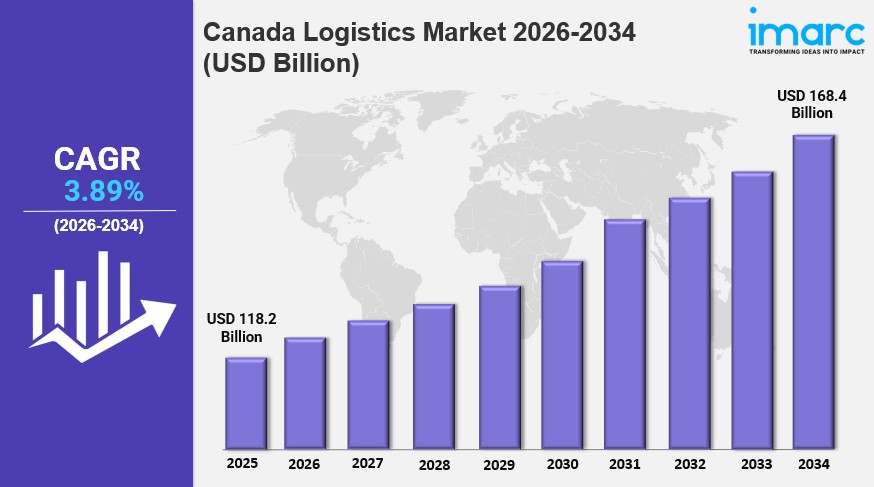
The Canada logistics market size reached USD 118.2 Billion in 2025 and is projected to reach USD 168.4 Billion by 2034, expanding at a CAGR of 3.89% during 2026-2034. In 2026, the market continues to gain momentum, fueled by e-commerce expansion, technological advancements, growing cross-border trade, and infrastructure spending.
Growth in 2026 is further reinforced by rising demand for effective supply chain solutions and sustainable operations, which consolidate operations and service delivery. These dynamics are expected to strengthen the Canada logistics market share throughout the forecast period.
Key Market Statistics at a Glance
- Base Year: 2025
- Historical Years: 2020-2025
- Forecast Period: 2026-2034
- Market Size (2025): USD 118.2 Billion
- Projected Market Size (2034): USD 168.4 Billion
- Growth Rate: CAGR of 3.89% (2026-2034)
Explore Opportunities in the Canada Logistics Market: Download the IMARC Sample Report: https://www.imarcgroup.com/canada-logistics-market/requestsample
Key Growth Drivers and Trends in the Canada Logistics Market
Growth in the Canada logistics market is being driven by the integration of advanced technologies. Logistics providers are using Artificial Intelligence (AI), Internet of Things (IoT), and machine learning to streamline route planning, track shipments in real time, and forecast demand variations. AI programs scan large volumes of data to identify optimal delivery routes based on traffic flow and weather patterns, while IoT offers real-time monitoring of goods, improving transparency and customer experience. In June 2025, UniUni, a tech-enabled logistics company based in Richmond, BC, was named “Last Mile Company of the Year” by SupplyTech Breakthrough. It uses AI-driven routing, robotic sorting, and real-time tracking, operates in over 500 North American cities, and reaches 80% of Canada’s population.
One of the leading Canada logistics market trends is the expansion of e-commerce and last-mile delivery solutions. Rapid e-commerce growth, particularly in urban areas, and customer demand for faster delivery are pushing logistics firms to improve last-mile efficiency. Firms are adopting micro-fulfillment centers, smaller warehouses located closer to consumers that enable rapid shipping, while drones and delivery robots are being used to speed up delivery and reduce its cost, making the sector more responsive and versatile.
Another key factor supporting Canada logistics market growth is rising cross-border trade and infrastructure spending, alongside demand for sustainable operations. Providers integrating fulfillment, delivery, returns, and real-time tracking, supported by smart routing and electric vehicles, are enhancing speed, efficiency, and environmental performance across the supply chain.
Speak to an Analyst: https://www.imarcgroup.com/request?type=report&id=37490&flag=C
Canada Logistics Industry Segmentation Insights
Breakup by Model Type:
- 2 PL: Second-party logistics, in which providers supply core transportation or asset-based services such as moving goods between locations.
- 3 PL: Third-party logistics, covering outsourced warehousing, fulfillment, delivery, and returns, as offered by providers such as GoBolt.
- 4 PL: Fourth-party logistics, in which providers manage and integrate the entire supply chain, including technology and partners, on behalf of clients.
Breakup by Transportation Mode:
- Roadways: Supports last-mile and long-haul movement of goods across Canada, with AI-driven routing and delivery innovation improving efficiency.
- Seaways: Supports cross-border and international trade through ports and maritime shipping.
- Railways: Moves bulk and long-distance freight across Canada’s vast geography.
- Airways: Serves time-sensitive and high-value shipments that require fast delivery.
Breakup by End Use:
- Manufacturing, Automotive and Construction: Rely on logistics for the inbound flow of materials and components and the outbound delivery of finished goods and heavy equipment.
- Consumer Goods, Retail and Food and Beverages: Driven by e-commerce growth, demand for faster delivery, and the need for responsive, temperature-sensitive supply chains.
- IT Hardware and Telecom: Depend on secure, time-critical transport and tracking of high-value equipment.
- Healthcare: Supported by supply chain efficiency tools such as Tecsys’ smart electronic shelf labels for hospital inventory management.
- Chemicals and Oil and Gas: Require specialized, compliant handling and transport for bulk and hazardous materials.
- Others: Covers additional industries relying on logistics services.
Breakup by Region:
- Ontario: A major regional market, analyzed in the report alongside the country’s other key provinces.
- Quebec: A key regional market covered in the report.
- Alberta: A significant regional market covered in the report.
- British Columbia: A key regional market, home to tech-enabled logistics players such as UniUni, based in Richmond.
- Others: Covers the remaining provinces and territories contributing to logistics demand.
Key Challenges and Growth Opportunities in the Canada Logistics Market
The Canada logistics market faces challenges including the cost of investing in new technologies and infrastructure, the complexity of serving a vast geography with dispersed population centers, and rising expectations for faster, more reliable, and more sustainable delivery.
Despite these challenges, the market offers considerable growth opportunities driven by e-commerce expansion, cross-border trade, and infrastructure spending. Continued adoption of AI, IoT, micro-fulfillment, and low-emission delivery solutions is expected to create substantial long-term opportunities.
Competitive Landscape
The Canada logistics market is competitive, with established providers and technology-led challengers such as GoBolt and UniUni investing in AI-driven routing, real-time tracking, and sustainable delivery. Market structure, key player positioning, top winning strategies, and company evaluation are central to how the competitive environment continues to evolve, as providers differentiate through technology and service quality.
Recent Developments in the Canada Logistics Market
- June 2025: GoBolt, a Toronto-based 3PL and last-mile logistics provider, was named “Overall Logistics Solution Provider of the Year” by the 2025 SupplyTech Breakthrough Awards. Recognized for sustainable, tech-driven solutions, GoBolt integrates fulfillment, delivery, returns, and real-time tracking, with smart routing and electric vehicles enhancing speed, efficiency, and environmental impact.
- June 2025: Tecsys Inc. launched ESL+, a smart electronic shelf label for hospital inventory management. Integrated with Tecsys’ Elite™ Point of Use platform, ESL+ enhances supply chain efficiency through real-time tracking, programmable restock features, and visual alerts, streamlining workflows and reducing waste.
- June 2025: UniUni, a tech-enabled logistics company based in Richmond, BC, was named “Last Mile Company of the Year” by SupplyTech Breakthrough, using AI-driven routing, robotic sorting, and real-time tracking to optimize last-mile delivery across 500+ North American cities.
Author IMARC Group
IMARC Group is a leading global market research company providing data-driven insights and expert consulting services to businesses seeking to achieve their strategic objectives. With a multidisciplinary team of industry experts, IMARC delivers reliable market intelligence across sectors including Chemicals and Materials, Healthcare, Technology, Agriculture, and Retail.
Contact Us:
IMARC Group
Email: sales@imarcgroup.com
United States: +1-201-971-6302

