IMARC Group has recently released a new research study titled “Mexico Network as a Service Market Size, Share, Trends and Forecast by Type, Application, End Use Industry, and Region, 2026-2034”, offering a detailed analysis of the market drivers, segmentation, growth opportunities, trends, and competitive landscape to understand the current and future market scenarios.
Mexico Network as a Service Market Size & Share 2026-2034
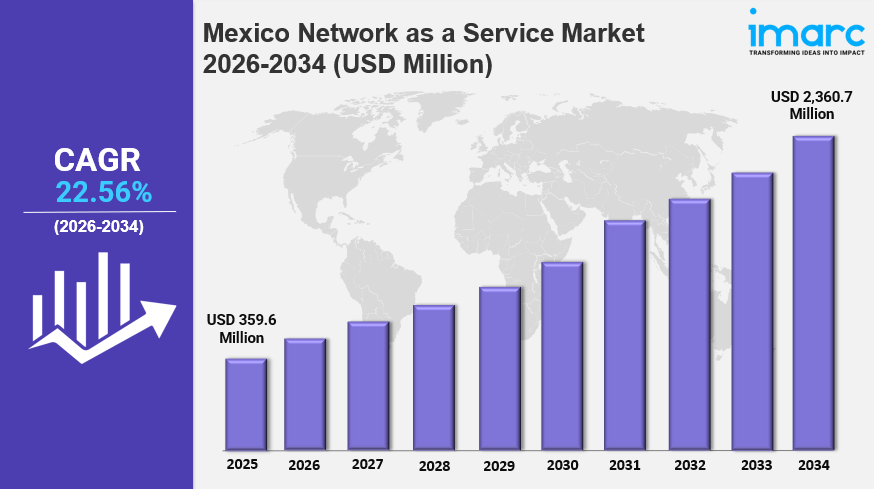
The Mexico network as a service market size reached USD 359.6 Million in 2025. Looking forward, IMARC Group expects the market to reach USD 2,360.7 Million by 2034, exhibiting a growth rate of CAGR of 22.56% during 2026-2034. Growing demand for cost-effective, flexible connectivity in underserved regions is driving consistent innovation and adoption.
Public-private partnerships and next-generation infrastructure rollouts across the country are significantly influencing the Mexico network as a service market demand, positioning it for sustained growth in the coming years.
Key Market Statistics at a Glance
- Base Year: 2025
- Historical Years: 2020-2025
- Forecast Period: 2026-2034
- Market Size (2025): USD 359.6 Million
- Projected Market Size (2034): USD 2,360.7 Million
- Growth Rate: CAGR of 22.56% (2026-2034)
Explore Opportunities in the Mexico Network as a Service Market: Download the IMARC Sample Report: https://www.imarcgroup.com/mexico-network-as-a-service-market/requestsample
Key Growth Drivers and Trends in the Mexico Network as a Service Market
Growth in the Mexico network as a service market is being driven by decentralized models reshaping connectivity, as operators adopt decentralized infrastructure to increase coverage while reducing operational costs. This shift enables more agile, scalable, and resilient network expansion without the need for large-scale capital investments in conventional cell towers. Movistar’s partnership with Helium to deploy decentralized wireless services for over 2.3 Million users across Mexico, using Helium Mobile Hotspots functioning as mini-cell towers, illustrates how this user-powered approach is opening new revenue streams and partnerships across the country.
One of the leading Mexico network as a service market trends is the growing use of hybrid satellite-LTE models driving rural inclusion, especially in underserved regions. This approach combines satellite and LTE technologies to overcome challenges of difficult terrain, poor infrastructure, and unreliable power supply. The Viasat and Altán joint launch of LTE broadband service over satellite across 13 states, featuring ultra-low-cost, often solar-powered LTE towers, has significantly improved rural digital inclusion and enabled essential services such as telemedicine, remote education, and digital commerce.
Another key factor supporting Mexico network as a service market growth is expanding cloud and connectivity infrastructure investment, exemplified by Alibaba Cloud’s launch of its first cloud region in Mexico and Sparkle’s new Tier-1 IP backbone point of presence in Querétaro. These developments are enhancing low-latency, secure infrastructure for startups and enterprises, accelerating digital transformation and supporting the country’s growing tech ecosystem.
Speak to an Analyst: https://www.imarcgroup.com/request?type=report&id=33496&flag=C
Mexico Network as a Service Industry Segmentation Insights
Breakup by Type:
- LAN-as-a-Service: Supports flexible, scalable local area network management for enterprises.
- WAN-as-a-Service: Enables agile, software-driven wide area network connectivity across distributed locations.
Breakup by Application:
- Cloud-based Services: Supports scalable, on-demand network infrastructure for enterprises and startups.
- Bandwidth on Demand: Provides flexible bandwidth allocation to meet fluctuating connectivity needs.
- Integrated Network Security-as-a-Service: Delivers embedded security capabilities across network infrastructure.
- Wide Area Network: Supports connectivity across geographically dispersed business locations.
- Virtual Private Network: Enables secure, private connectivity for remote and distributed teams.
Breakup by End Use Industry:
- Healthcare: Requires reliable connectivity to support telemedicine and digital health services.
- BFSI: Depends on secure, high-performance networks for financial transactions and services.
- Retail and E-Commerce: Utilizes flexible network infrastructure to support digital commerce operations.
- IT and Telecom: Represents a core adopter of network as a service solutions for infrastructure scalability.
- Manufacturing: Requires robust connectivity to support automation and industrial digitalization.
- Transportation and Logistics: Relies on network services for real-time tracking and supply chain coordination.
- Public Sector: Utilizes network as a service solutions to expand digital government infrastructure and rural connectivity.
Breakup by Region:
- Northern Mexico: Benefits from a strong industrial and manufacturing base supporting network services demand.
- Central Mexico: Holds a significant share supported by dense enterprise and IT infrastructure activity.
- Southern Mexico: An emerging region with growing connectivity investment supporting rural digital inclusion.
- Others: Comprises smaller regional markets experiencing gradual growth in adoption.
Key Challenges and Growth Opportunities in the Mexico Network as a Service Market
The Mexico network as a service market faces challenges including the technical complexity of deploying reliable connectivity infrastructure in difficult terrain and underserved regions, along with the need for continued investment in decentralized and hybrid network technologies.
Despite these challenges, the market offers considerable growth opportunities driven by continued expansion of decentralized wireless models, rising adoption of hybrid satellite-LTE connectivity, and growing cloud infrastructure investment from global technology providers. Continued public-private partnerships aimed at closing Mexico’s persistent connectivity gaps are expected to create substantial opportunities for long-term growth in the Mexico network as a service market.
Competitive Landscape
The Mexico network as a service market is competitive, with established players focusing on infrastructure expansion, decentralized network models, and strategic partnerships to strengthen their market position. Companies are investing in cloud regions, Tier-1 IP backbone expansion, and hybrid satellite-LTE deployments to support the growing connectivity needs of enterprises and underserved communities across Mexico.
Author IMARC Group
IMARC Group is a leading global market research company providing data-driven insights and expert consulting services to businesses seeking to achieve their strategic objectives. With a multidisciplinary team of industry experts, IMARC delivers reliable market intelligence across sectors including Chemicals and Materials, Healthcare, Technology, Agriculture, and Retail.
Contact Us:
IMARC Group
Email: sales@imarcgroup.com
United States: +1-201-971-6302

