IMARC Group has recently released a new research study titled “United States Electric Bus Market Report by Propulsion Type (Battery Electric Vehicle (BEV), Fuel Cell Electric Vehicle (FCEV), Plug-in Hybrid Electric Vehicle (PHEV)), Battery Type (Lithium-ion Battery, Nickel-Metal Hydride Battery (NiMH), and Others), Length (Less than 9 Meters, 9-14 Meters, Above 14 Meters), Range (Less than 200 Miles, More than 200 Miles), Battery Capacity (Up to 400 kWh, Above 400 kWh), and Region 2026-2034”, offering a detailed analysis of the market drivers, segmentation, growth opportunities, trends, and competitive landscape to understand the current and future market scenarios.
United States Electric Bus Market Size & Share 2026-2034
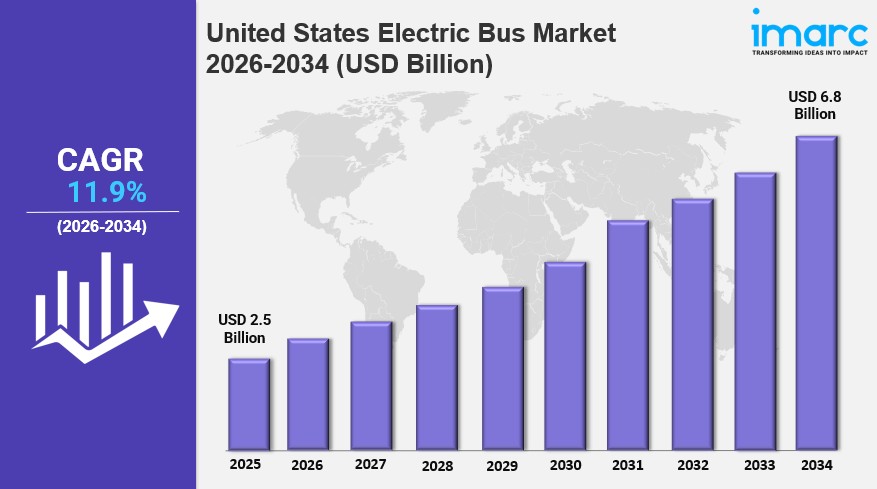
The United States electric bus market size reached USD 2.5 Billion in 2025 and is projected to reach USD 6.8 Billion by 2034, expanding at a CAGR of 11.9% during 2026-2034. In 2026, the market continues to gain momentum, propelled by growing environmental concerns, stricter emission control regulations, expanding charging infrastructure, and continuous advances in battery and electric drive technologies.
Growth in 2026 is further reinforced by government initiatives and subsidies for zero-emission buses, falling lithium-ion battery costs, and the lower operating and maintenance costs of electric buses compared with diesel models. These dynamics are expected to strengthen the United States electric bus market share throughout the forecast period.
Key Market Statistics at a Glance
- Base Year: 2025
- Historical Years: 2020-2025
- Forecast Period: 2026-2034
- Market Size (2025): USD 2.5 Billion
- Projected Market Size (2034): USD 6.8 Billion
- Growth Rate: CAGR of 11.9% (2026-2034)
Explore Opportunities in the United States Electric Bus Market: Download the IMARC Sample Report: https://www.imarcgroup.com/united-states-electric-bus-market/requestsample
Key Growth Drivers and Trends in the United States Electric Bus Market
Growth in the United States electric bus market is being driven by the need to curb greenhouse gas emissions and urban air pollution from diesel buses. According to Environment America, replacing all diesel-powered transit buses in the country with electric buses could reduce greenhouse gas emissions by more than 2 million tons per year. Regulatory and funding support is reinforcing this shift: in March 2024, the U.S. Environmental Protection Agency released a final rule setting stricter greenhouse gas limits for heavy-duty vehicles for model years 2028-2032, and in November 2023, the Federal Highway Administration announced USD 5 Billion under its Low or No Emission Vehicle Program to replace transit buses with zero-emission models.
One of the leading United States electric bus market trends is the growth of charging infrastructure and grid technology. The United States reached nearly 128,000 EV charging stations in 2022, while fast-charging and vehicle-to-grid (V2G) technologies are improving operational efficiency. In July 2023, Blue Bird launched its next-generation Vision electric school bus supporting 80 kW fast charging, and in May 2024, Oakland Unified School District became the first major U.S. school district to fully electrify its school bus system with V2G technology, using a fleet of 74 electric buses delivered by Zum.
Another key factor supporting United States electric bus market growth is the adoption of hydrogen fuel cell mobility for long-range, high-demand routes. According to Calstart, about 6,100 new full-size zero-emission transit buses entered service in the United States in 2023, a 12% increase over 2022, while the number of fuel cell electric buses surged by more than 75%. In April 2024, BAE Systems announced it would supply its next-generation electric drive system to GILLIG for a new hydrogen fuel cell bus line.
Speak to an Analyst: https://www.imarcgroup.com/request?type=report&id=6239&flag=C
United States Electric Bus Industry Segmentation Insights
Breakup by Propulsion Type:
- Battery Electric Vehicle (BEV): Powered entirely by batteries recharged from the grid, producing zero tailpipe emissions and playing a key role in reducing urban air pollution.
- Fuel Cell Electric Vehicle (FCEV): Uses hydrogen fuel cells to generate electricity, emitting only water vapor and suiting long-range and high-demand routes.
- Plug-in Hybrid Electric Vehicle (PHEV): Combines an internal combustion engine with a rechargeable battery, offering flexibility for longer ranges and reducing range anxiety.
Breakup by Battery Type:
- Lithium-ion Battery: Preferred for its high energy density, lighter weight, and compact size, enabling longer distances on a single charge.
- Nickel-Metal Hydride Battery (NiMH): Offers stability and safety with lower risk of thermal runaway, though with lower energy density and shorter range than lithium-ion.
- Others: Includes additional battery chemistries serving specialized needs.
Breakup by Length:
- Less than 9 Meters: Smaller buses suited to inner-city routes, narrow streets, shuttle services, and last-mile connectivity.
- 9-14 Meters: The standard city bus for most U.S. public transit systems, serving regular urban and suburban routes with moderate passenger volumes.
- Above 14 Meters: Designed for high-capacity routes, including busy urban corridors, intercity services, and Bus Rapid Transit (BRT) systems.
Breakup by Range:
- Less than 200 Miles: Typically used for urban routes with frequent stops, including inner-city transit, school buses, and shuttle services.
- More than 200 Miles: Used for intercity and longer urban routes and BRT systems, handling higher daily mileage with less frequent recharging.
Breakup by Battery Capacity:
- Up to 400 kWh: Used for shorter urban and suburban routes, with lower purchase and operating costs and less charging infrastructure investment.
- Above 400 kWh: Supports longer routes and higher-capacity needs, offering greater operational flexibility for intercity and BRT applications.
Breakup by Region:
- Northeast: Supported by aggressive clean energy policies and incentives, including subsidies, tax credits, and grants for transitioning to electric buses.
- Midwest: Driven by government initiatives, public awareness, and public-private partnerships supporting zero-emission transit and school bus deployment.
- South: Shaped by state-level policies and regulations on clean energy and transportation infrastructure that influence adoption rates.
- West: Led by states such as California, which have numerous air quality and climate change mitigation policies driving the shift to electric buses.
Key Challenges and Growth Opportunities in the United States Electric Bus Market
The United States electric bus market faces challenges including high initial costs, inadequate charging infrastructure, battery degradation, and the significant time required to charge buses.
Despite these challenges, the market offers considerable growth opportunities as ongoing research and development in battery technology improves energy density, charging speed, and overall efficiency, which are expected to lower costs and enhance performance over time. Lower operating costs, reduced maintenance, and lower fuel costs compared with diesel buses continue to encourage transit agencies to shift to electric fleets.
Competitive Landscape
The United States electric bus market is competitive, with bus manufacturers such as Blue Bird and GILLIG, electric drive suppliers such as BAE Systems, and service providers such as Zum advancing zero-emission portfolios for transit and school fleets. Companies are investing in battery technology, fast charging, V2G capabilities, and hydrogen fuel cell platforms, while partnerships with transit agencies and school districts continue to shape the competitive environment.
Recent Developments in the United States Electric Bus Market
- May 2024: The Metropolitan Transportation Authority (MTA) launched new electric buses on Queens, Brooklyn, and Staten Island routes, fitted with charging stations to ensure sufficient power for charging.
- May 2024: Zum delivered a fleet of 74 electric school buses with bidirectional chargers to Oakland Unified School District, which became the first major U.S. school district to fully electrify its school bus system with V2G technology.
- April 2024: The U.S. Environmental Protection Agency (EPA) announced the commencement of its 2024 Clean Heavy-Duty Vehicles Grant Program to assist the transition of school buses, trucks, and other heavy-duty vehicles to zero-emission models.
- April 2024: BAE Systems announced it would provide its next-generation electric drive system to GILLIG for use in a new hydrogen fuel cell bus line.
Author IMARC Group
IMARC Group is a leading global market research company providing data-driven insights and expert consulting services to businesses seeking to achieve their strategic objectives. With a multidisciplinary team of industry experts, IMARC delivers reliable market intelligence across sectors including Chemicals and Materials, Healthcare, Technology, Agriculture, and Retail.
Contact Us:
IMARC Group
Email: sales@imarcgroup.com
United States: +1-201-971-6302

