IMARC Group has recently released a report titled “Mexico Logistics Market Size, Share, Trends and Forecast by Model Type, Transportation Mode, End Use, and Region, 2026-2034”, providing a comprehensive analysis of market trends, competitive landscape, and regional dynamics.
Mexico Logistics Market Size and Forecast 2026–2034
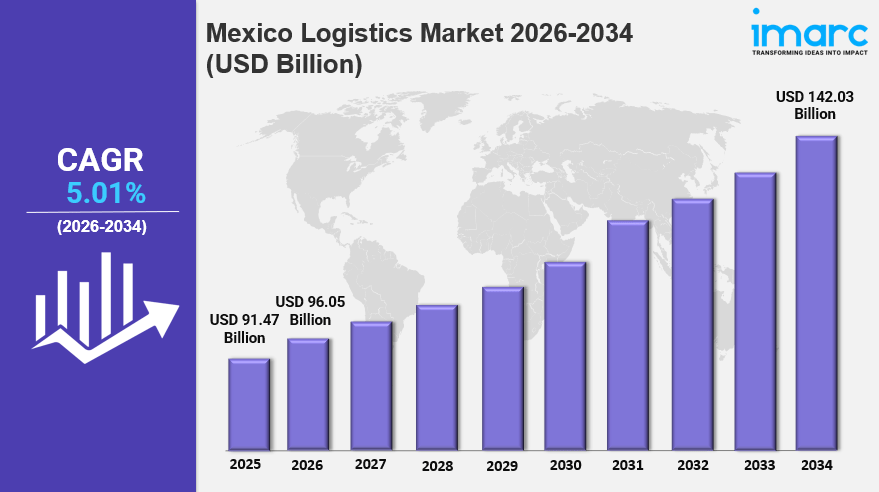
The Mexico logistics market size increased from USD 91.47 Billion in 2025 to USD 96.05 Billion in 2026. Looking forward, IMARC Group expects the market to reach USD 142.03 Billion by 2034, exhibiting a growth rate (CAGR) of 5.01% during 2026–2034. The strategic geographical positioning of Mexico as a gateway for North American trade, accelerating nearshoring activities from multinational corporations, and the rapid expansion of e-commerce platforms demanding efficient last-mile delivery solutions represent some of the key factors driving the market.
In 2026, the Mexico logistics market growth is being fueled by continued nearshoring-driven demand for warehousing, freight, and customs clearance operations across major industrial corridors, alongside rapid digitalization of retail channels requiring sophisticated last-mile delivery solutions. Infrastructure modernization spanning highways, ports, and railway systems, along with the increasing adoption of third-party logistics providers and multimodal transportation networks, is further strengthening operational efficiency and intensifying competition among logistics providers.
Key Market Statistics at a Glance
- Base Year: 2025
- Historical Years: 2020–2025
- Forecast Period: 2026–2034
- Market Size (2025): USD 91.47 Billion
- Market Size (2026): USD 96.05 Billion
- Projected Size (2034): USD 142.03 Billion
- Growth Rate: CAGR of 5.01%
- Leading Model Type (2025): 3 PL, with a 46% share
- Leading Transportation Mode (2025): Roadways, with a 59% share
- Leading End Use Segment (2025): Manufacturing, with an 18% share
- Leading Region (2025): Northern Mexico, with a 46% share
Explore Opportunities in the Mexico Logistics Market: Download the IMARC Sample Report: https://www.imarcgroup.com/mexico-logistics-market/requestsample
Mexico Logistics Market Growth: Key Trends and Market Insights
The Mexico logistics market growth is significantly supported by accelerating nearshoring activities, which have generated substantial demand for warehousing facilities, freight services, and customs clearance operations across major industrial corridors. In September 2025, Amazon, Mercado Libre, and GEODIS announced a combined USD 1.1 Billion investment in the State of Mexico’s logistics sector, expanding distribution centers and logistics infrastructure. The strategic geographical positioning of the country continues to serve as a critical enabler for North American trade integration, benefiting from established trade agreements that facilitate cross-border commerce.
Key Mexico logistics market trends include the growing digital transformation of logistics operations, with providers increasingly deploying artificial intelligence, IoT sensors, and blockchain solutions to enhance real-time tracking, predictive analytics, and automated warehouse management. In October 2025, Salesforce announced a USD 1 Billion investment in Mexico to expand AI-driven operations and establish a Global Delivery Center. The market is also witnessing expanding multimodal transportation networks, with the 73-hectare U.A.C Logistics Park near Veracruz port inaugurated in June 2025 to support integrated road, rail, sea, and air freight capabilities.
The Mexico logistics market growth is further being supported by rising sustainability and green logistics initiatives, including the transition toward electric and alternative fuel vehicles and renewable-powered warehousing facilities. In May 2025, GEODIS and Prologis launched a 619 kW rooftop solar project at Prologis Park Grande, Tepotzotlán, generating 892 MWh annually. These evolving Mexico logistics market trends are expected to create opportunities for logistics providers while supporting broader supply chain efficiency and resilience nationwide.
Speak to an Analyst: https://www.imarcgroup.com/request?type=report&id=16217&flag=C
Mexico Logistics Market Segmentation Analysis
The Mexico logistics market is segmented by model type, transportation mode, end use, and region, offering a comprehensive view of outsourcing patterns, freight movement, and regional dynamics across the country.
Breakup by Model Type
- 2 PL: Covers basic transportation and freight services provided directly by carriers without broader supply chain management.
- 3 PL: The leading segment with a 46% share in 2025, driven by manufacturers and retailers outsourcing complex supply chains to optimize costs, improve scalability, and enhance service flexibility. In December 2025, DP World opened a 117,000-square-foot multi-customer warehouse in Querétaro, strengthening 3PL capabilities and supporting nearshoring.
- 4 PL: Provides end-to-end supply chain orchestration, integrating multiple logistics providers and technology platforms for comprehensive management.
Breakup by Transportation Mode
- Roadways: The dominant transportation mode with a 59% share in 2025, owing to extensive highway networks, last-mile flexibility, and cost efficiency. In June 2025, Mexico’s SICT announced a MX$53.3 Billion investment to modernize and expand the national highway network.
- Seaways: Supports international trade and bulk cargo movement through the country’s port infrastructure.
- Railways: Provides cost-effective, high-capacity freight transportation for long-haul and bulk shipments.
- Airways: Serves time-sensitive and high-value cargo requiring rapid transit.
Breakup by End Use
- Manufacturing: The leading end-use segment with an 18% share in 2025, driven by Mexico’s strength in automotive, electronics, and consumer goods, demanding integrated logistics and resilient supply chain coordination. In April 2025, Volvo announced a USD 1 Billion investment to expand its heavy-duty truck manufacturing plant in Nuevo León.
- Consumer Goods: Benefits from rising domestic consumption and distribution network expansion.
- Retail: Supported by omnichannel strategies connecting physical stores with digital fulfillment.
- Food and Beverages: Requires temperature-controlled and time-sensitive logistics solutions.
- IT Hardware: Relies on secure, high-value cargo handling and specialized logistics protocols.
- Healthcare: Depends on specialized logistics for temperature-sensitive and regulated products.
- Chemicals: Requires hazardous materials handling and specialized transportation protocols.
- Construction: Supports the movement of building materials and heavy equipment.
- Automotive: Benefits from nearshoring-driven manufacturing investment and just-in-time delivery requirements.
- Telecom: Supports the distribution of network equipment and infrastructure components.
- Oil and Gas: Requires specialized logistics for energy sector operations.
- Others: Includes additional end-use sectors supported by the broader logistics ecosystem.
Breakup by Region
- Northern Mexico: The leading region with a 46% share in 2025, owing to proximity to United States borders, dense maquiladora clusters, industrial parks, and established trade corridors enabling efficient cross-border freight flows.
- Central Mexico: Benefits from its position as the country’s primary economic hub, hosting significant manufacturing and distribution activity.
- Southern Mexico: Represents a growing logistics market supported by expanding infrastructure and port connectivity.
- Others: Includes additional regions witnessing growing logistics activity as infrastructure investment continues to expand.
Key Challenges and Growth Opportunities in the Mexico Logistics Market
The Mexico logistics market faces several challenges that could affect its growth, including infrastructure bottlenecks and capacity constraints at congested transportation corridors and border crossings, cargo theft and security concerns along transportation routes, and skilled workforce shortages, particularly among experienced truck drivers and supply chain management specialists.
Despite these challenges, the market offers significant growth opportunities driven by accelerating nearshoring and manufacturing relocation activities, rapid e-commerce expansion requiring sophisticated last-mile delivery networks, and sustained infrastructure modernization enhancing multimodal connectivity. Companies investing in digital logistics platforms, sustainable transportation solutions, and workforce development will be well positioned to strengthen their competitive advantage through 2034.
Competitive Landscape
The Mexico logistics market demonstrates a fragmented competitive landscape marked by the coexistence of global logistics enterprises, regional operators, and niche service providers catering to varied industry requirements. Competitive analysis covering market structure, key player positioning, and top winning strategies has been provided in the report, along with detailed profiles of major companies operating in the space.
Companies compete by differentiating their service portfolios, geographic reach, technological integration, and sector-specific expertise, with strategic alliances, mergers, and acquisitions continuing to influence market dynamics. Recent developments illustrate this momentum: in 2025, DHL invested USD 60 Million in Mexico to expand its ground delivery fleet by 300 vehicles ahead of El Buen Fin; and in June 2025, Amazon Mexico partnered with Rappi to launch Amazon Now, delivering essential products in under 15 minutes across the country’s 10 largest cities. Increasing investments in digital platforms, automation, and sustainability initiatives continue to shape competitive priorities across the logistics ecosystem.
Author IMARC Group
IMARC Group is a leading global market research company providing data-driven insights and expert consulting services to businesses seeking to achieve their strategic objectives. With a multidisciplinary team of industry experts, IMARC delivers reliable market intelligence across sectors including Chemicals and Materials, Healthcare, Technology, Agriculture, and Retail.
Contact Us:
IMARC Group
Email: sales@imarcgroup.com
United States: +1-201-971-6302

